International leadership: Dr Marijana Prodanović brings together European experts to develop the UNINOVIS multilingualism strategy
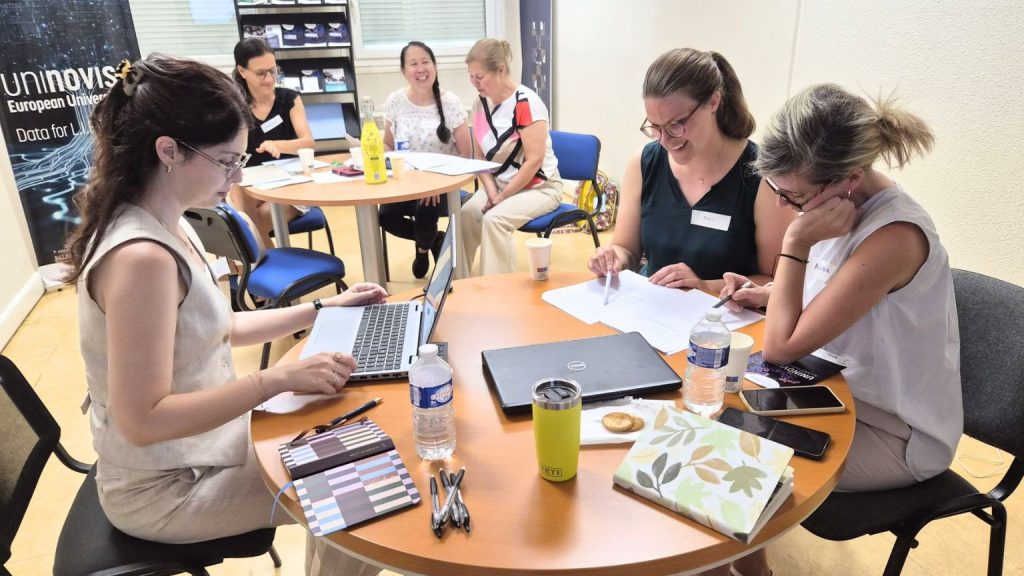
The Faculty of Arts and Education at Kauno kolegija Higher Education Institution is proud to celebrate the professional achievements and international academic leadership of Assoc. Prof. Dr Marijana Prodanović from the Language Centre. On June 24–25 at the Université Sorbonne Paris Nord in France, and on July 1 in a virtual format, Dr M. Prodanović successfully led intensive training sessions and strategic workshops for the multilingualism initiative team of the UNINOVIS European University Alliance.
From vision to action in Paris
The goal of this initiative is to develop a long-term, comprehensive strategy that promotes lifelong language learning and enhances intercultural exchanges across all eight partner institutions of the alliance, which together represent over 150,000 students and 12,000 staff members.
Guided by the principle of inclusive communication, an international team of experts brought together by Dr M. Prodanović – representing Finland (TAMK), Germany (THWS), the Netherlands (THUAS), France (USPN), and Albania (University of Tirana) – conducted an in-depth mapping of the language programs offered at each institution.
This work established a solid foundation for the future alliance strategy. Notably, Dr M. Prodanović drafted the initial policy document, which has been shared with partners for feedback and evaluation.
During the training sessions and discussions, the key focus was placed on the following topics:
- Multilingual learning pathways and their integration into study programmes;
- Promoting intercultural mobility;
- The application of micro-credentials;
- Staff capacity building and professional development;
- The synergy between artificial intelligence, modern translation tools, and language learning.
Multilingualism: embracing cultural wealth over Englishisation
Dr M. Prodanović emphasises that the drafted document aims to demonstrate a comprehensive commitment to European Union values by promoting diversity, which is primarily expressed through language and culture.
While English remains a strong global lingua franca, Englishisation is not the core of this strategy. On the contrary, the main goal is to highlight and leverage the existing linguistic and cultural wealth of the alliance partners.
‘Of course, English will not be sidelined, as it ensures seamless communication, but space will be created for other languages – recognising them and offering ways to integrate them more actively into daily and academic activities,’ says Dr M. Prodanović.

Interculturality: a deeper experience beyond soft skills
According to the Associate Professor, intercultural awareness and sensitivity are not just about avoiding social faux pas. Instead, they represent the ability to empathise, understand others’ perspectives, and enrich oneself through real-life experiences.
‘Sometimes, even a simple greeting in someone’s native language can be appreciated as a significant gesture of respect. I hope this multilingualism strategy will open new horizons, encourage people to learn new languages, and foster openness to cultural diversity and the wider world,’ she shares.
The final alliance strategy is expected to be published in various languages of the UNINOVIS members, accompanied by a practical guide containing essential tips for intercultural communication.
Scientific expertise building international bridges
Assoc. Prof. Dr M. Prodanović is a recognised researcher in intercultural communication, multilingualism, and academic language. Holding a PhD in linguistics, her active scientific endeavors span Serbia, Bosnia and Herzegovina, Spain, and Lithuania, where her research delves into how different languages and cultures shape academic discourse.
She also shares her expert knowledge on major international platforms. At the prestigious UNIVERSEH conference ‘No Language, No Alliance’, held on June 29–30 in Düsseldorf, Germany, Dr M. Prodanović presented the vision for the UNINOVIS multilingualism strategy and participated in discussions regarding the future of linguistic diversity within European university alliances.
This extensive international experience enables Dr M. Prodanović to successfully build bridges of cooperation, directly contributing to raising the quality of studies and strengthening the international prestige of Kauno kolegija Higher Education Institution.