

In order to nurture the values of Kauno kolegija Higher Education Institution – responsibility, professionalism, openness, respect, and a sense of community – it is essential for us as individuals and community to create a work and academic environment, which would be favourable, democratic, safe, open to respect and assistance. Unfair and disrespectful treatment of a person is not acceptable at Kauno kolegija Higher Education Institution. Therefore in case of intolerable actions, we encourage to speak and act.
Ethics
- Is a lecturer constantly late for the lecture?
- Did you notice plagiarism or copying?
- Do you experience psychological violence or bullying from the student(s), lecturers, or other staff?
- Did you notice a bribe offer/acceptance?
- Do you encounter or notice other cases of unethical and intolerable behaviour?
The Kauno kolegija Higher Education Institution Code of Academic Ethics defines the principles and norms of ethical conduct of institution’s community members. Each member of the Kauno kolegija Higher Education Institution community undertakes to comply with the Code of Academic Ethics provisions and shall not tolerate its violations. Violations must be reported to the Ethics Committee.
The Ethics Committee of Kauno kolegija Higher Education Institution, the structure of which has been approved for the period of 2023–2026 consists of 7 people. They investigate reports and/or appeals about the activity of the members of the institution’s community (administration staff, teaching staff, other staff, and students) that are contrary to the norms of academic ethics. The Ethics Committee shall not review anonymous reports.
The Ethics Committee ensures the full confidentiality of the submitted report and/or complaint about possible ethical violations and guarantees that the information about the person who submitted the report shall not be disclosed to other individuals not involved in the activities of the Ethics Committee. The recommended data must be provided when inquiring and reporting a violation to ensure accountability.
Notices and/or appeals regarding possible violations of the Code of Academic Ethics can be sent by e-mail at etika@go.kauko.lt or submitted in a written form directly to the Loreta Valatkevičienė, Chair of the Ethics Committee.
More information:
Code of Academic Ethics of Kauno kolegija Higher Education Institution
Office of the Ombudsperson for Academic Ethics and Procedures of the Republic of Lithuania
Office of the Equal Opportunities Ombudsperson
Trust Line
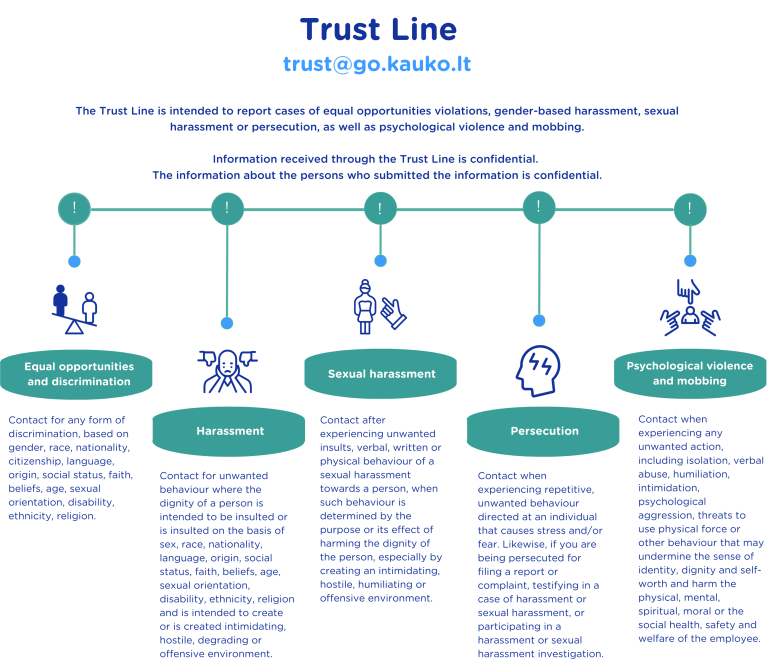
The Trust Line is for reporting violations of equal opportunities, gender-based harassment, sexual harassment or persecution, and psychological violence and mobbing.
- Equal opportunities
- Harassment
- Sexual harassment
- Persecution
Equal opportunities are the implementation of human rights consolidated in international human and civil rights documents and laws of the Republic of Lithuania regardless of gender, race, nationality, citizenship, language, origin, social status, religion, beliefs or opinions, age, sexual orientation, disability, ethnicity, religion.
Harassment is unwanted conduct where the gender of a person is intended to offend or insult the dignity of a person and to create an intimidating, hostile, degrading, or offensive environment.
Sexual harassment is unwanted sexual behaviour of a person, expressed through verbal, oral, written, or physical action, where such conduct is influenced by an object or effect that is detrimental to the person’s dignity, in particular by creating an intimidating, hostile, degrading or offensive environment.
Persecution is treating a person less favourably than others because of a report or complaint, testimony in the case of reporting about sexual harassment, participation in the investigation of (sexual) harassment.
Psychological violence and mobbing
Relationships based on the force imbalance in the workplace, resulting in consistent long-term misconduct against an employee that impairs the other employee’s physical, social or psychological well-being, reduces productivity, and job satisfaction. A single person can use psychological violence and mobbing with collective approval or greater influence and a group of employees.
Psychological violence and mobbing are most often the results of harassment, bullying, insulting, threats, unconstructive, degrading criticism, verbal aggression, persecution, and other misconduct. Psychological violence and mobbing usually occur in more than one form of ill-treatment, mainly harassment (when repeatedly and intentionally exploited, threatened and/or humiliated, etc.) and violence (when one or more employees or managers are attacked with the intention of violating a person’s dignity and (or) create a hostile work environment).
Cases of psychological violence and mobbing in the workplace are characterised by (but not limited to):
- threats (for example, dismissal, deterioration of working conditions, etc.);
- underestimation of achievements (for example, criticism of an employee in the forms of humiliation and insulting because of the tasks performed);
- defamation (for example, the dissemination of unrealistic information that may harm a person’s honour and dignity. Defamation is often intended to accuse another person of non-existent things, etc.);
- repeated negative remarks (for example, unpleasant comments of different content, etc.);
- ignoring (for example, isolation, separation from the team and collaborative activities, not disclosing the information, etc.);
- manipulation (for example, inadequate workload, wage manipulation, unrealistic requirements, etc.);
- unfounded criticism (for example, destructive criticism of an employee in the forms of humiliation and insulting because of the tasks performed);
- sarcasm (for example, mockery, scathing irony, etc.);
- the desire to make fun of (for example, the behaviour of an employee or group of employees when the personal and professional characteristics of another person are ridiculed, ridiculous remarks about the employee, or associative jokes create a hostile and unethical environment in which the employee feels abused, humiliated, etc.);
- yelling (for example, communication in a raised tone, uncontrollable emotions, etc.);
The information received by the Trust Line is not publicly available. The data of the individuals who provided the information is confidential.
An established committee investigates reports and/or appeals of violations of equal opportunities, harassment, sexual harassment, persecution, psychological violence, and mobbing. E-mails and/or appeals can be sent to trust@go.kauko.lt.
More information:
- Policy on ensuring the psychological security of the staff and procedure for implementing it
- Policy on equal opportunities and the procedure for its implementation
- Procedure for identifying measures to reduce stress at work
- The programme of equal opportunities and diversity at Kauno kolegija Higher Education Institution
Equal opportunities and diversity
The Kauno kolegija Higher Education Institution Gender Equality Plan for 2026–2030 is a strategic document by which Kauno kolegija Higher Education Institution commits to consistently and systematically pursue gender equality in all areas of activity, promoting cultural and structural changes within the institution.
The aim of the plan is to promote institutional cultural change in the field of gender equality by establishing a sustainable, data-driven equality policy, strengthening the integration of gender aspects into studies and applied research and artistic activities, reducing structural inequality and hidden bias in staff recruitment, career development, and decision-making, increasing the visibility of underrepresented groups, introducing effective measures for work-life balance, ensuring the implementation of the zero-tolerance principle towards violence and harassment, and guaranteeing consistent monitoring and accountability in the implementation of the Gender Equality Plan.
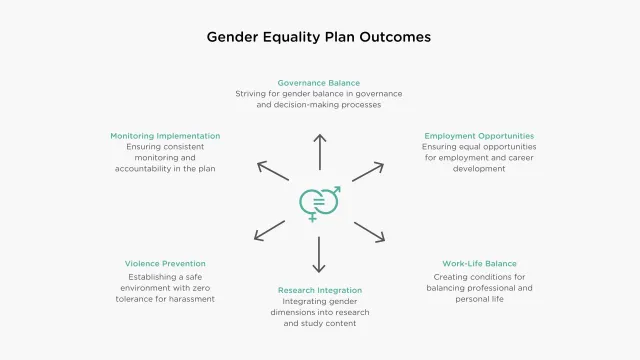
The implementation of the Plan is based on the consistent integration of actions into the Kauno kolegija Higher Education Institution’s annual activity planning and periodic monitoring.
Psychological help
Kauno kolegija Higher Education Institution provides free psychological help for students who experience difficulties related to studies or personal life. Every student is welcome to consult when feeling down, anxious, lonely, sad, or hopeless, when affected by personal problems at work, relationship, loss of a family member, eating disorders, alcohol, drug abuse, etc.
Additionally, psychological counseling is available not only for personal issues and issues related to psychological health, but also for study matters, for instance, when encountering difficulties in communication with others or overall decision making, or when facing difficulties in time planning, effective learning, lack of motivation or issues with public speaking.
We kindly invite students of Kauno kolegija Higher Education Institution to take the opportunity and enroll in free psychological counseling.
Psychologists provide free advice through the most convenient channel for them, in Lithuanian and English.
For remote consultation, you can email greta.aksamitauskiene@go.kauko.lt. The consultation takes place between 8 a.m. and 17 p.m., at an advance by email agreed time.